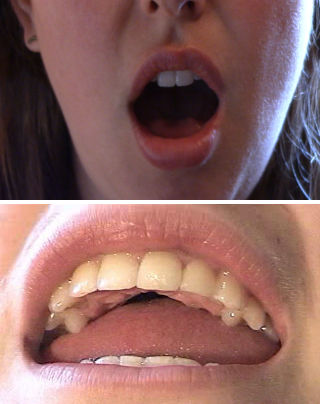
I begin by asking the student to say “EER”. Invariably, the response is “EEO” (O as in BOUGHT). They are usually not stimulable and do not have a facilitating context that I can add to EER to get the correct sound. They typically will drop the jaw and tongue together and exaggerate lip rounding (as seen in the top picture). These are significant indicators because an important goal of saying “EER” correctly is to differentiate the tongue movement from the lips and jaw. Generally, when “EER” is said correctly, the tongue stays wide on the back molars and slides back slightly while the lips and jaw are stationary with the mouth 1/3 to 1/2 open (bottom picture).
I begin using the visual modality right away modeling correct versus incorrect tongue placement. I demonstrate the correct “EER” and mimic the student’s “EER” and ask the student to tell me what is different between the two. I tell the student to watch my tongue, particularly the sides of my tongue and see what is different. Usually they can see and describe that the sides of my tongue stay up on my top teeth while theirs drop down. This metacognitive approach is important because the student needs to know exactly what the components are for producing the correct R sound.
Using a mirror and a flashlight, I ask them to say EE with a big smile. I will say, “Do you see how your tongue is wide and touching the back teeth? That’s exactly what we want!”
We then work on EE-EE-EE with the 3rd EE pushing the tongue back with an infant tongue depressor well under the tongue while the jaw is stabilized typically using 3 sticks taped together as shown in the following photo:
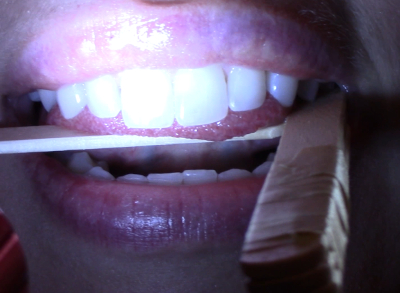
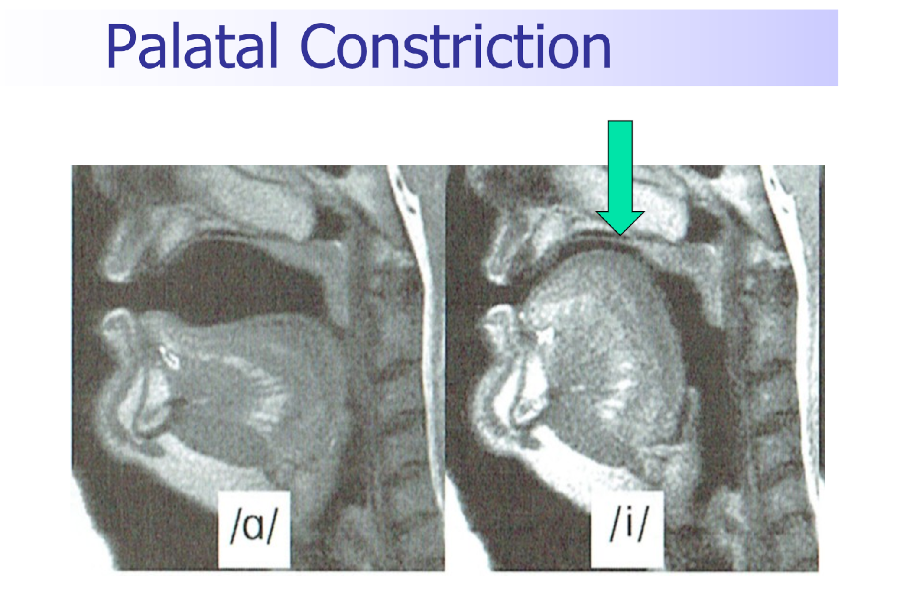
Using this technique, it is not unusual to get a correct R sound as the stick under the tongue and pushing back is creating the palatal constriction that is necessary to say the correct R. It doesn’t matter if you get a correct R at this point but the productions should be close.
I will typically add a facilitating context. If the student has a high palatal arch, my facilitating context will be either EERNA or EERSHA (A as in CAT) which are more in the front or middle of the palate. If there is no issue with a high palatal arch, I will often use EERGA which pulls the tongue farther back and with coarticulation, gets the dorsum up which helps for palatal constriction. The reason for the A sound at the end is due to coarticulation, it will lead to pharyngeal constriction, the 2nd necessary constriction needed for making a correct R sound.
Lots and lots of repetitions are needed to establish the sound and then I use the SATPAC Program’s lists which systematically move the student into more and more difficult contexts.
To really understand what I am talking about and you having the ability to ask questions, I recommend you sign up for the first two of three free 3-hour SATPAC live presentations on September 11 and October 23 from 9:00 to 12:15 Pacific Time The first webinar concentrates on understanding the SATPAC Program and remediating the S sound while the second is mostly about R remediation.
Or, if you are unable to fit this into your schedule, you can watch recorded webinars of the same material. Here are the links to register:
- Part 1: https://docs.google.com/forms/d/e/1FAIpQLSfqMjvjdUKMB0AmVVZHvv5IQqAnaSW_O9L4jd0zwoqNdGqjIw/viewform
- Part 2: https://docs.google.com/forms/d/e/1FAIpQLSesUwz39mMUAkmFsoP30Jgonh5lCA4QmUbvCT9Ave_aMUXCFw/viewform
Stephen Sacks
SATPAC Speech
Recipient of the Van Hattum Award for Contribution in the Schools
P.S. Contact steve@satpac.com if you are interested in having me present webinars to your school district or organization. Also, I’ve been quite successful remediating those hard articulation cases that you might still be having difficulty with after a few years. That’s why I’m writing as my private practice kids are almost all remediated! So, if you would like to refer to me, just use my email address above.