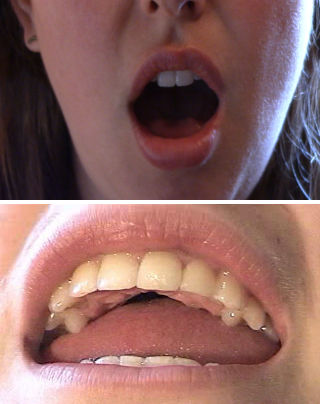
There are numerous reasons why it is so difficult to remediate the R sound. I’m going to be writing a series of newsletters dealing with the R sound. If you put together everything that I’m writing, you will develop the knowledge and skill to remediate the R sound in your practice.
Why Remediating the R Sound is Challenging
One reason remediation is so difficult is that the sound requires two types of constriction: palatal constriction and pharyngeal constriction. That is, the space between the palate and the dorsum needs to be narrowed for palatal constriction and the space between the root of the tongue and the pharyngeal area needs to be closed for pharyngeal constriction. In the image, the pharyngeal constriction is seen on the left.
Understanding R Sound Physiology
The following MRI images are from the chapter by Suzanne E. Boyce on the R sound in the book Eliciting Sounds – Techniques and Strategies for Clinicians by Wayne A. Secord.
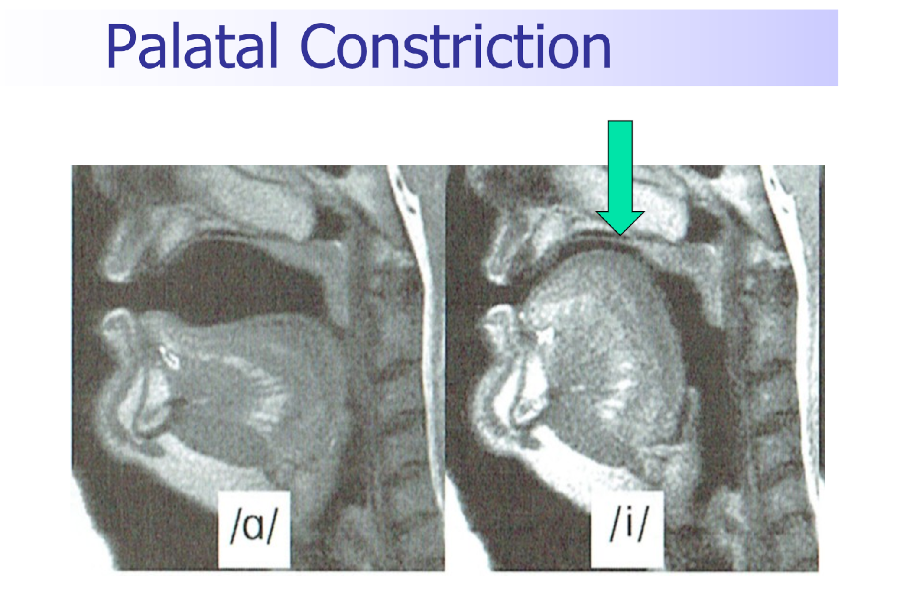
You can observe excellent palatal constriction when the EE sound is said as the arrow above points out.
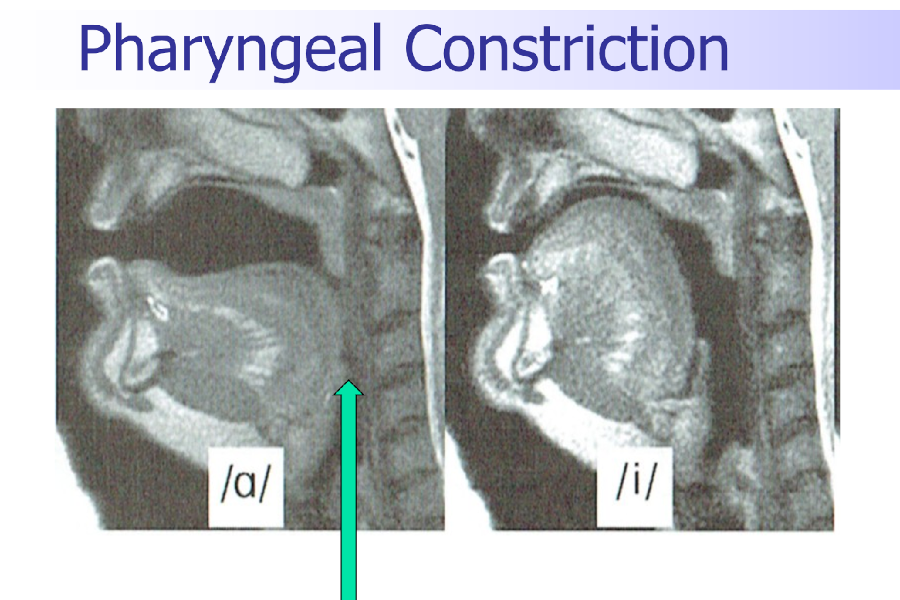
In the MRI above (as in the word talk), you can observe that the pharyngeal area is closed by the root of the tongue.
The SATPAC Program: Systematic R Remediation
I begin remediation using a postvocalic R which is typically more difficult but more visible than the prevocalic R and once developed, is easier to transfer to a prevocalic R than vice versa. In the SATPAC Program, which develops systematic lists for remediation, I begin using the nonwords EERNA, EERSHA or EERGA in my remediation lists with excellent success. Usually, one of those three will work better for the student based on the structure of the palate. The reason for beginning with EER, using the EE sound, is that the tongue is wide and stabilized on the molars (lateral bracing) which is required for most sounds and important for coarticulation transitions. The EE sound also gets the mouth approximately 1/3 open (jaw grading) which is also the same opening you need for the R sound. The reason for A at the end in EERNA, EERSHA or EERGA is because it is close to the a sound in talk. Because of coarticulation, the student will move from no pharyngeal closure with the EE to appropriate pharyngeal closure with the A.
Announcement: Welcoming Patty Yandell to SATPAC Speech
Announcement: SATPAC Speech is pleased to announce the affiliation with Patty Yandell, the developer of RTIC SLP on Instagram and TPT. Patty contacted me about a year ago asking if it was OK to use SATPAC materials for a presentation for the California Speech Association convention which she did. After many hours of conversation over the past year, I was so impressed that I asked her to work in conjunction with her company and SATPAC Speech. She has a breadth of knowledge about remediating speech sounds based on her background in athletics, hospital work, school therapy, and private practice that is impressive and has given her experiences seldom seen in our profession. Her approach to therapy is totally consistent with the development of the appropriate motor skills needed for remediation of speech sound deficits which is what I have used in SATPAC as it is systematic, effective, and efficient. I recently learned that she has used SATPAC for 21 years! Patty will be presenting R remediation videos on a regular basis which can also be found on the SATPAC website.
Coming Next Month
Next month’s Newsletter: How to get a correct postvocalic R in the first speech session.